Chronic Knee Pain Help in Knoxville, TN: When It Won't Go Away

SEO title: Chronic Knee Pain Help Knoxville TN | Knox Chiro
URL slug: /blog/chronic-knee-pain-help-knoxville-tn-when-it-wont-go-away
Meta description: Looking for chronic knee pain help knoxville tn? Learn why pain lingers, how assessment, progressive rehab, and shockwave therapy can support lasting progress.
If you’re looking for chronic knee pain help knoxville tn, you may already feel like you’ve tried everything. Rest may have helped for a few days. A brace, medication, stretching routine, or short course of treatment may have made a difference at first. Then the pain returned.
That experience can be discouraging, especially when knee symptoms begin affecting sleep, stairs, exercise, work, or simple walks around your home in Knoxville.
Long-standing knee pain often needs a different approach than a recent strain. The goal isn’t just to make the sore spot feel better for a short time. It’s to understand what may be keeping the problem going and build your ability to move with more comfort and confidence.
Why long-standing knee pain behaves differently
When pain continues for months or years, your body can begin adapting around it. These changes are real, and they can affect how your knee feels and functions.
Your pain system can become more sensitive
Pain is influenced by more than the condition of a joint, tendon, or muscle. When an area has been irritated for a long time, the nervous system may become more protective. Movements that once felt normal can start to feel threatening or uncomfortable.
This doesn’t mean the pain is imaginary. It means the body may be responding to movement with a higher level of caution than it did before.
Muscles may begin to guard
When your knee hurts, the muscles around your hip, thigh, and lower leg may tighten to protect you. At first, this can be helpful. Over time, constant guarding can make movement feel stiff and tiring.
You may notice that you:
- Keep your knee straighter than usual
- Avoid putting your full weight on one side
- Take shorter steps
- Turn your foot outward to feel safer
- Use your arms more when standing up
- Avoid stairs, squats, or uneven ground
These changes can become automatic. You may not realize how much your movement has changed until someone carefully observes it.
Strength and confidence can fade
If an activity repeatedly causes pain, it’s natural to do less of it. But avoiding movement for too long can reduce strength and endurance. The knee may then have less support during everyday tasks.
This can create a frustrating cycle:
Pain leads to less movement. Less movement leads to reduced capacity. Reduced capacity makes normal activities feel harder.
Breaking that cycle usually takes patience and a plan that starts at the right level.
Why one generic plan may not work for everyone
Two people can have similar knee symptoms but very different reasons for experiencing them.
One person may have reduced hip strength. Another may be compensating for an ankle or foot problem. Someone else may have become sensitive after an old injury, surgery, or long period of inactivity. A runner, a weightlifter, and an older adult who wants to walk comfortably may all need different progressions.
That’s why a routine that helps one person may irritate another.
At Knox Chiro, we take time to listen to your history, understand what you’ve tried, and learn how your symptoms affect your daily life. We also look at movement, strength, balance, posture, and how the knee responds to different activities before creating a customized treatment plan.
What chronic knee pain help knoxville tn should include
A helpful plan should look beyond the exact place where you feel soreness.

Treat the driver, not only the sore spot
The knee is part of a connected movement system. Your hip, pelvis, ankle, foot, and lower back can all influence how force travels through the leg.
For example, if your hip is not controlling your leg well, your knee may absorb more stress during stairs, running, or lifting. If your ankle lacks mobility, your body may find another way to complete the movement. If your trunk leans or rotates to avoid discomfort, the load may shift again.
This doesn’t mean your knee is never the source of the problem. It means the full movement pattern deserves attention.
Use a thorough assessment
A careful assessment may include:
- Your health and injury history
- When symptoms began and what makes them better or worse
- Walking and stair mechanics
- Squat, step, and balance patterns
- Hip, knee, and ankle range of motion
- Strength and endurance
- Areas of muscle tightness or guarding
- Your current activity goals
The goal is not to label every movement as “bad.” It’s to understand what your body is currently doing and identify a reasonable starting point.
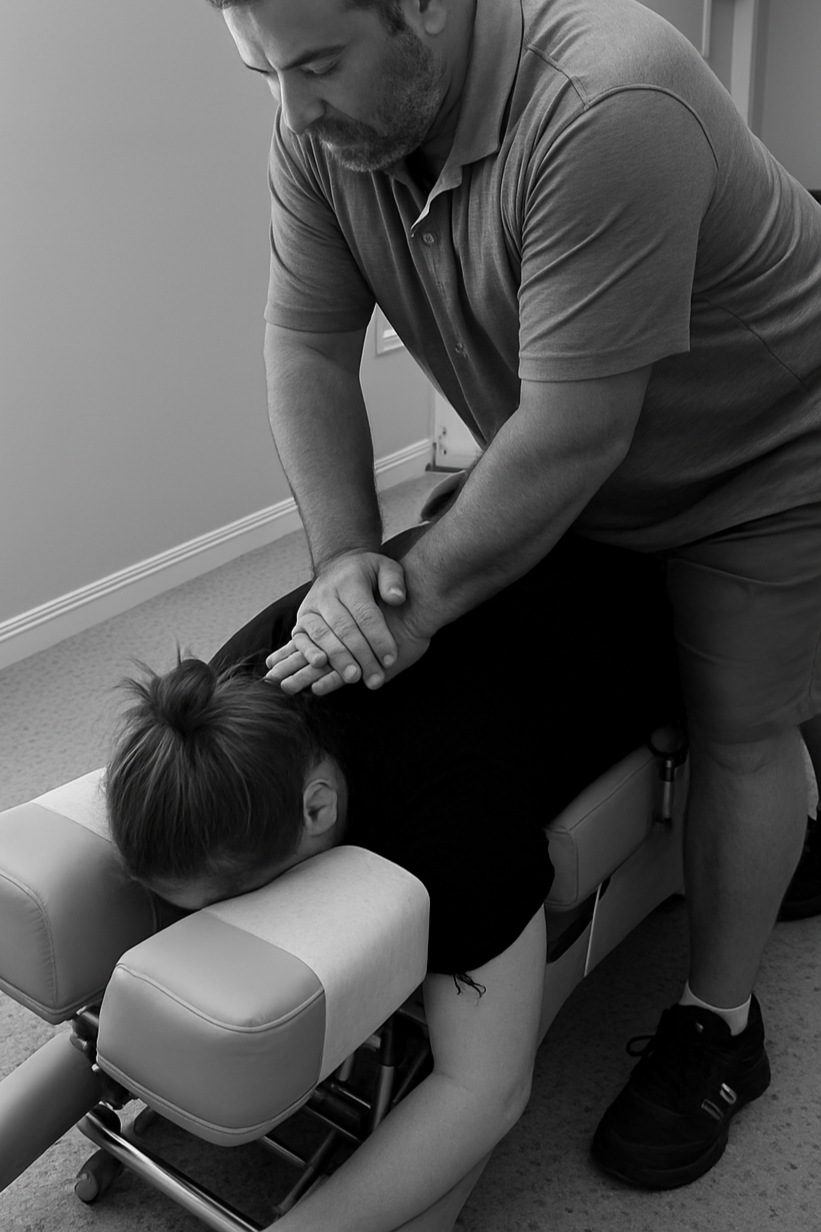
Our first-visit approach includes a conversation about your health history, followed by posture and movement checks. If our care is a good fit, we can begin hands-on treatment and discuss the next steps.
Why slow, consistent loading usually wins
When knee pain has been present for a long time, aggressive treatment can sometimes create a short-term flare-up without building lasting capacity.
Progressive loading works differently. You begin with an amount of movement or resistance your body can manage. Then, as tolerance improves, the challenge gradually increases.
That may include:
- Comfortable range-of-motion exercises
- Sit-to-stand practice
- Supported step-ups
- Hip and thigh strengthening
- Balance exercises
- Walking or cycling
- Gradual return to squats, running, or lifting
The exact exercises depend on your assessment and goals. Someone hoping to return to running may eventually need hopping, landing, and running drills. Someone focused on walking comfortably may begin with controlled weight shifting and short, manageable walks.
The principle is the same: build capacity without repeatedly overwhelming the area.

How we manage flare-ups
A flare-up doesn’t always mean you’ve caused new damage. It may mean the recent activity was more than your current capacity, or that your body is temporarily more sensitive.
Instead of fearing every increase in symptoms, we can use it as information. We may adjust:
- The number of repetitions
- The amount of resistance
- The exercise range
- The frequency of activity
- Rest between sets
- Walking distance or speed
This approach helps you stay involved in your recovery without swinging between doing nothing and doing too much.
You should still seek prompt medical care for symptoms such as a major injury, sudden inability to bear weight, a hot and severely swollen joint, fever, unexplained calf swelling, or a knee that repeatedly locks. A thorough evaluation can help determine whether chiropractic care is appropriate or whether another type of medical assessment is needed.
Where shockwave therapy may fit
When tissue quality, chronic tightness, or local sensitivity limits progress, shockwave therapy may be considered as part of a broader plan.
Shockwave therapy uses sound waves directed at a treatment area. At our clinic, it may be used to support care for stubborn muscle, tendon, and ligament problems. It is non-invasive and drug-free, but it should not be viewed as a replacement for active rehabilitation.
The most useful question is often not, “Can this treatment fix my knee by itself?” Instead, it’s:
Can this help reduce discomfort enough for me to participate in the movements that build strength and function?
That is why shockwave therapy, when appropriate, is paired with assessment, education, and rehabilitative exercises. You can learn more about how we explain the process in our Shockwave Therapy: The Basics Explained video.
Current rehabilitation guidance generally supports exercise, progressive strengthening, education, and self-management as central parts of care for persistent knee symptoms. A Cochrane review of land-based exercise also found meaningful short-term improvements in pain and function for people with knee osteoarthritis.
Expect progress in weeks, not days
When a problem has been present for months or years, lasting improvement usually takes time. You may notice small changes first:
- Standing up feels a little easier
- You recover faster after activity
- Stairs feel less intimidating
- You can walk farther before symptoms increase
- You feel more confident loading the leg
- Your knee is less reactive the next day
These changes often build over several weeks. The timeline depends on your condition, activity level, sleep, stress, consistency, and how your body responds to the plan.
We won’t promise that every knee problem changes overnight. We will help you understand what we’re seeing, what you can work on, and how we’ll adjust care as you progress.
Whether your goal is returning to running, lifting weights, staying active as you age, or simply walking comfortably through your day, you deserve a plan built around your body and your life.
Take the next step in Knoxville
If you’re in Whittle Springs, North Knoxville, or nearby, we’d be happy to listen and help you understand your options. We care for patients of all ages and focus on personalized care, thorough assessment, and practical steps toward better movement.
Call us at (865) 687-5700, or fill out our contact form and ask us to call you back. The next step can be simple: tell us what’s been happening, and we’ll help you decide where to begin.