Knee Pain Treatment in Knoxville, TN: What Care Actually Looks Like

SEO title: Knee Pain Treatment Knoxville TN: Care Guide
URL slug: knee-pain-treatment-knoxville-tn
Meta description: Learn what knee pain treatment knoxville tn looks like, from your first assessment to personalized care, home exercises, progress checks, and clear next steps at our local clinic.
If you’re looking for knee pain treatment knoxville tn, you may be wondering what actually happens after you schedule an appointment. Will someone simply adjust your knee? Will you be given exercises and sent home? How do you know whether the care is helping?
At Dr. Arthur Poisal Chiropractic, we start by listening. Your knee pain may be connected to the knee itself, but it may also involve your hip, lower back, ankle, foot, movement habits, or a previous injury. That’s why no two knees receive the same plan.
Our clinic serves patients throughout Knoxville, including the Whittle Springs and North Knoxville areas. We’re located at 3371 Whittle Springs Road, Knoxville, TN 37917, and we care for patients of all ages.
Your first visit starts with a thorough assessment
Your first visit is about understanding the full picture. Before we recommend treatment, we’ll talk with you about:
- When your symptoms started
- Whether the problem began with an injury
- Activities that make your knee feel better or worse
- Previous treatment, imaging, or surgery
- How your knee affects sleep, exercise, work, and daily movement
- Your goals, whether that means running, lifting, playing with your children, or walking more comfortably
We’ll also assess how your body moves. This may include observing your walking pattern, balance, squatting motion, step-down control, and general lower-body coordination.
A hands-on exam helps us evaluate joint movement, muscle tension, tenderness, range of motion, and the way your knee responds to controlled movement. We may also look at your hip, pelvis, lower back, ankle, and foot. These areas can influence how force travels through your leg.

After the assessment, we’ll explain what we found in plain language. You’ll have an opportunity to ask questions, and we’ll discuss whether our approach is appropriate for your needs. If your symptoms suggest that you need imaging or evaluation from another healthcare provider, we’ll explain that as well.
Knee pain treatment knoxville tn: choosing the right tools
There isn’t one treatment tool that works for every person. We select care based on your symptoms, movement findings, health history, and response over time.
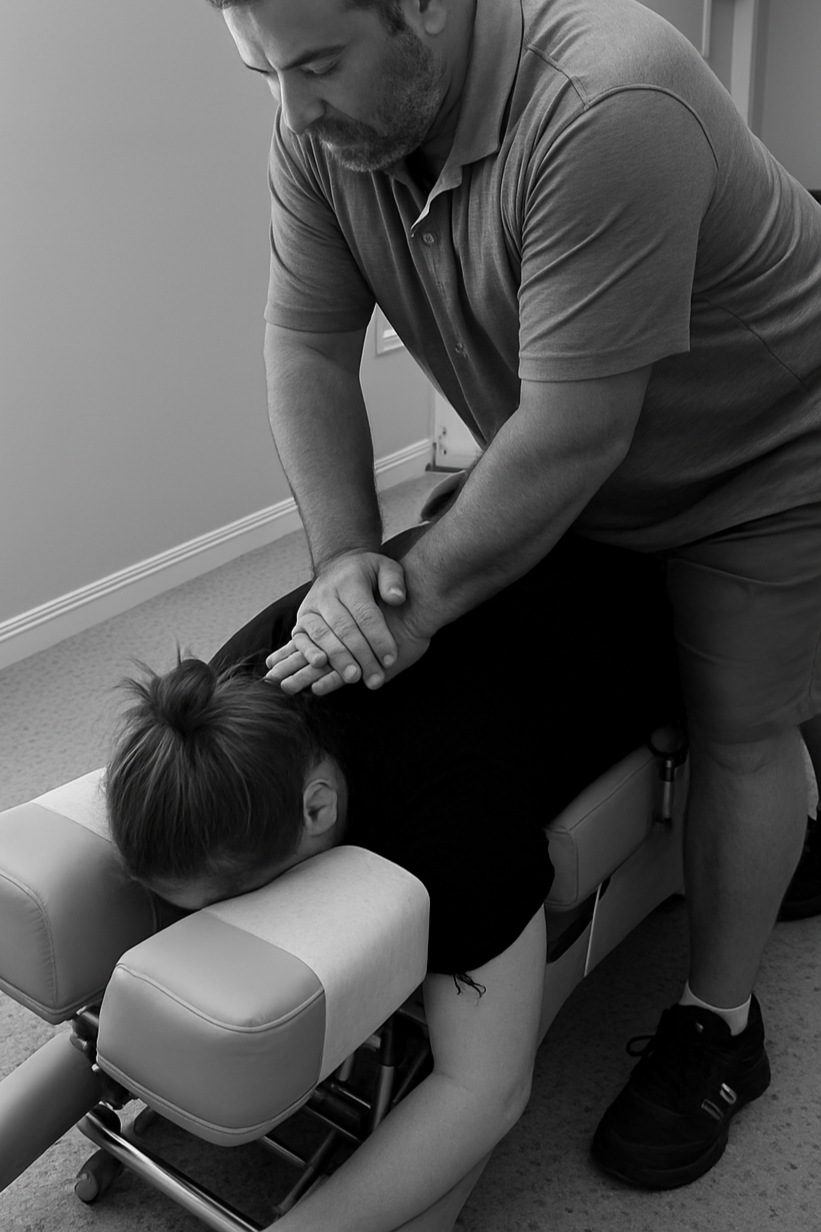
Gentle joint work and adjustments
Some patients benefit from gentle work directed at the knee, ankle, hip, pelvis, or spine. The goal is to support comfortable movement and address restrictions that may be affecting how your leg functions.
Adjustments are not performed automatically or forcefully. We consider your age, comfort level, medical history, and current symptoms. Care for an active adult recovering from an overuse problem may look very different from care for an older adult managing stiffness and reduced mobility.
Hands-on care is often one part of a broader plan. It may be combined with movement retraining, soft-tissue techniques, and exercises that help you maintain progress between visits.
Shockwave therapy for persistent soft-tissue pain
Shockwave therapy may be considered when pain involves a chronic tendon or other soft tissue that has not responded well to rest or basic care. It uses a handheld device to deliver focused mechanical pulses to a targeted area.
Patients often describe the sensation as rhythmic tapping or pressure. The intensity can be adjusted based on your comfort.
This approach may be useful for certain problems involving tissues around the kneecap or the tendons above and below the knee. It is not used simply because you have knee pain. We first determine whether the treatment fits your presentation.
You can learn more about how our clinic explains this service in our shockwave therapy video.

Decompression therapy when the lower back or hip is involved
Sometimes the knee is carrying more stress because of a problem higher up the chain. Lower-back irritation, hip stiffness, or changes in movement can affect how you walk and load the knee.
In those cases, decompression therapy may be considered as part of care for the lower back. This is not the same as treating the knee directly. Instead, it may help address contributing symptoms in the spine when they are part of the overall picture.
We’ll only include decompression therapy when it makes sense for your assessment. It is one option among several, not a required part of every plan.
Rehabilitative exercises matched to your knee
Exercises help you build control, strength, balance, and confidence. Your program may include movements for the quadriceps, hamstrings, glutes, calves, hips, or core.
The right exercises depend on what you can safely tolerate. Some patients may begin with gentle range-of-motion work or supported strengthening. Others may be ready for squats, step-ups, balance drills, or activity-specific movements.
If you’re a runner, your plan may eventually include running mechanics and gradual return-to-training steps. If you lift weights, we may discuss modifications that let you stay active while reducing unnecessary stress. If your goal is simply to walk comfortably, your exercises will focus on steady, practical progress.
What a typical course of care looks like
The length and frequency of care vary. We don’t want to place you on an automatic schedule without knowing how your body is responding.
Early visits may focus on reducing irritation, improving comfortable movement, and helping you understand what to do at home. As your symptoms become more manageable, the focus may shift toward strength, stability, coordination, and returning to your normal activities.
During follow-up visits, we may check:
- Your pain level and symptom pattern
- Walking and stair movement
- Knee range of motion
- Strength and balance
- Tolerance for exercise
- Ability to complete daily activities
- Progress toward your personal goals
Progress is not measured only by whether your knee feels better on the treatment table. We also want to know whether you can sleep more comfortably, move through your day with less hesitation, and participate in the activities that matter to you.
What you can do between visits
Your actions between appointments can make an important difference. We’ll give you clear instructions based on your assessment. These may include:
- Completing a short home exercise program
- Taking movement breaks instead of staying in one position for long periods
- Adjusting training volume temporarily
- Using comfortable, controlled movement rather than avoiding all activity
- Paying attention to which activities increase symptoms
- Following guidance about rest, ice, or other supportive strategies
You don’t need a complicated routine to make progress. A few well-chosen exercises performed consistently are often more useful than a long list that feels impossible to maintain.

How we know when to change course
Your plan should respond to your progress. If your symptoms are improving, we may gradually increase exercise difficulty or help you return to more demanding activities.
If progress is slower than expected, we’ll reassess. We may modify an exercise, change the treatment emphasis, address another area, or recommend additional evaluation. Worsening symptoms, new swelling, instability, locking, inability to bear weight, or significant pain after an injury may require prompt medical assessment.
Changing course is not a failure. It is part of responsible, individualized care. Our goal is to understand what your knee needs now rather than continue with a plan simply because it was the first one we tried.
A personalized plan can help you move forward
Knee symptoms can affect every part of your day. They may change how you climb stairs, exercise, sleep, work, or spend time with family. You deserve care that considers more than the location of your discomfort.
At Dr. Arthur Poisal Chiropractic, we take time to listen, assess how you move, and explain your options. Our services include spinal and joint adjustments, decompression therapy, shockwave therapy, and rehabilitative exercises. Each plan is built around the person in front of us.
If you’d like to discuss knee pain treatment knoxville tn, call us at (865) 687-5700. You can also fill out our contact form, and we’ll be happy to call you back.