Runner's Knee Treatment in Knoxville: Get Back to Your Miles

SEO title: Runner's Knee Treatment Knoxville | Get Back to Miles
Suggested URL slug: /blog/runners-knee-treatment-knoxville-get-back-to-your-miles
Meta description: Looking for runner's knee treatment Knoxville runners can trust? Learn what causes kneecap pain, how we assess it, and how to return to running with confidence.
That dull ache around or behind your kneecap can make every run feel uncertain. You may notice it on stairs, during downhill sections, or after sitting at your desk for a while. If you’ve been searching for runner's knee treatment knoxville, you may be dealing with patellofemoral pain.
The good news is that runner’s knee does not automatically mean your knee is worn out. In many cases, it’s a tracking and load problem. The kneecap is not moving as smoothly as it should while your leg bends and straightens. With the right assessment and a gradual plan, you can often return to running with more comfort and confidence.
What runner’s knee really means
Runner’s knee is a common name for patellofemoral pain. It describes pain around or behind the kneecap, rather than one specific injury.
Your kneecap helps your quadriceps transfer force as you run, climb stairs, squat, or stand from a chair. Every stride places a load through that system. If your hip, knee, ankle, or foot is not sharing that load well, the kneecap may become irritated.
This does not necessarily mean there is serious damage inside your knee. It may mean your body is asking one area to do more work than it can comfortably handle right now.
That can happen after:
- A sudden increase in weekly mileage
- Adding hills or downhill running too quickly
- Weakness or poor control in the hips and glutes
- Limited ankle mobility
- Worn-out running shoes
- Too little recovery between hard efforts
- Changes in training surface, speed, or volume
The pain may be mild at first. You might finish a run without much trouble, then feel the ache later that evening. Over time, it can begin to affect stairs, squats, long drives, or getting up after sitting.
Why stairs and sitting can hurt
Stairs and downhill running increase the demand on the muscles that control your knee. If your hip drops inward or your knee moves toward the middle of your foot, the kneecap may experience more stress.
Sitting for a long time can also bring on symptoms. Your knee stays bent, and the kneecap remains in contact with the thigh bone. When you stand up, that irritated area has to start moving again.
Pain in these situations does not mean you have to give up running. It does mean your current training load and movement patterns deserve a closer look.

Runner's Knee Treatment Knoxville Runners Can Personalize
At Dr. Arthur Poisal Chiropractic, we start by listening. We want to know when your symptoms began, what changed in your training, what movements make the pain worse, and what you want to get back to doing.
A thorough assessment may include:
- Walking and running movement patterns
- Hip strength and single-leg control
- Knee tracking during a step-down or squat
- Ankle mobility and foot loading
- Range of motion in the ankle, knee, hip, and lower back
- Training volume, recovery, footwear, and running surfaces
We do not want to treat only the place that hurts. Your knee may be the area sending the warning signal, while the contributing issue may involve your hip, ankle, foot, or overall movement strategy.
Your plan should fit your body and your goals. A young athlete preparing for a season may need a different approach from an experienced runner training for a distance event. We also care for adults who want to keep walking, exercising, lifting weights, or staying active as they age.
How we help your knee move better
Once we understand what is contributing to the problem, we can create a customized treatment plan. The goal is to improve motion, reduce unnecessary stress, and rebuild your confidence in the leg.
Restore motion in the ankle, knee, and hip
A stiff ankle can make it harder for your knee to move through a comfortable running position. Limited hip motion may also change how your thigh and kneecap track.
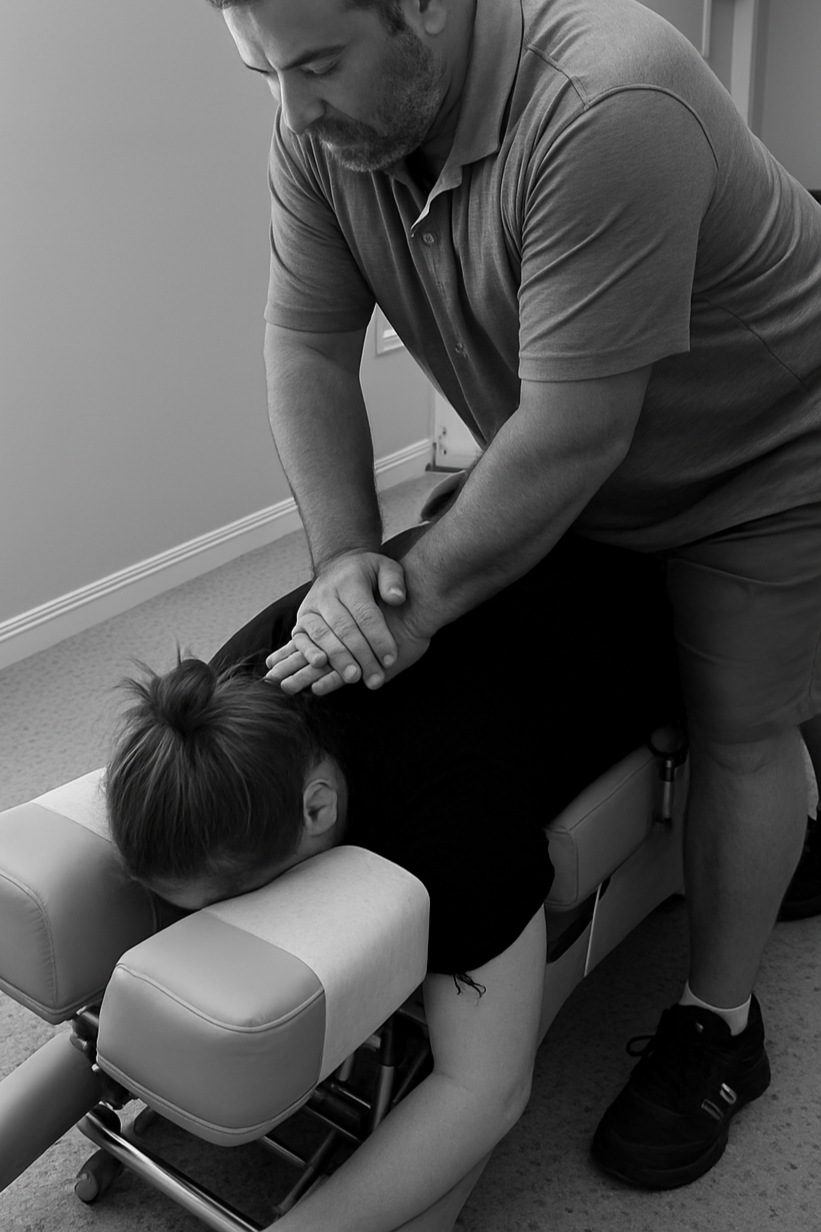
Gentle hands-on joint work can help restore movement where it is restricted. Depending on your needs, care may include adjustments and mobility techniques for the spine, pelvis, hip, knee, or ankle.
Not every runner needs the same treatment. We take time to monitor how your body responds and adjust your plan as you progress.
Use shockwave therapy when appropriate
Some runners also have stubborn irritation in nearby tendons or soft tissues. Shockwave Therapy may be considered as part of a broader plan when it is appropriate for your symptoms.
Shockwave Therapy uses sound waves to support the body’s healing response. It is non-invasive and drug-free. It is not a replacement for correcting the movement or training factors that contributed to your symptoms, but it may be a useful addition for selected cases.
You can learn more about how this therapy works in our Shockwave Therapy basics video.
Rebuild hip and knee control
Mobility is only one part of recovery. You also need the strength and coordination to control your leg when your foot meets the ground.
Rehabilitative exercises may focus on:
- Glute strength
- Hip rotation and side-to-side control
- Single-leg balance
- Step-down mechanics
- Calf and ankle strength
- Controlled squatting and lunging
- Gradual running-specific drills
The goal is not to make you perform a long list of exercises forever. It is to help you build the control needed for your normal activities and running goals.

Keep training while your knee heals
Stopping all activity can be frustrating, especially if running is part of your identity or your stress relief. In many cases, you may be able to keep moving while your knee calms down.
That might mean temporarily:
- Replacing a long run with a shorter, easy effort
- Using flat routes instead of hills
- Reducing speed work
- Switching some sessions to cycling, swimming, or strength training
- Adding rest between demanding workouts
- Avoiding back-to-back days that provoke symptoms
A useful guide is how your knee responds during the activity and over the next 24 hours. Mild symptoms that settle quickly may be manageable. Pain that steadily increases, changes your stride, or lingers into the next day is a sign to reduce the load and check in with a professional.
You do not have to prove anything by running through worsening pain. Smart training adjustments can help you stay active without turning a manageable problem into a longer setback.
A realistic return-to-running timeline
Every runner heals at a different pace. Your timeline depends on how long you have had symptoms, how irritated the knee is, your strength and mobility, and how closely your training load matches your current capacity.
Some runners feel meaningful improvement within a few weeks after making the right changes. Others need several weeks or longer to rebuild strength and return to their normal mileage. A gradual progression may look like:
- Walking comfortably on level ground
- Performing strength exercises with good control
- Using short walk-run intervals
- Increasing easy running time before speed or distance
- Adding hills and faster work later
- Returning to normal training with planned recovery
You should not need to run with fear that one uncomfortable stride will ruin your progress. We will help you understand what your symptoms mean, what your knee can tolerate now, and how to move forward safely.
If your pain is severe, follows a significant injury, causes noticeable swelling or locking, or does not improve with conservative care, further medical evaluation may be appropriate. We can help you understand when another type of assessment may be needed.
Get back to the running you enjoy
Whether you run through North Knoxville, near the Whittle Springs area, or on your favorite local route, you deserve care that considers your whole movement pattern and your personal goals.
At Dr. Arthur Poisal Chiropractic, we take time to listen before creating a plan. We work with patients of all ages, including young athletes, active adults, and runners who simply want to walk comfortably again. Our focus is practical progress: better movement, less uncertainty, and lasting results that support the activities you value.
You can also visit our frequently asked questions to learn more about what to expect from care.
Ready to take the next step? Call us at (865) 687-5700, or fill out our contact form and we’ll be happy to call you back.