Best Chiropractor for Knee Pain in Knoxville: How to Choose

When you’re searching for the best chiropractor for knee pain knoxville, you may wonder whether a chiropractor, physical therapist, orthopedist, or simply more time is the right next step.
The answer depends on how your pain started, how much it affects your movement, and whether you have signs of a more serious injury. A thoughtful provider should never treat every knee problem the same way.
Here’s how to compare your options and choose a care team that listens, examines the whole picture, and helps you move forward safely.
First, decide whether you need urgent medical care
A chiropractor may be a good first stop for gradual or non-traumatic knee discomfort. However, some symptoms call for prompt medical evaluation.
Consider an orthopedist, sports medicine physician, or urgent care provider if your knee pain began after a major fall, collision, or twisting injury. You should also seek medical attention if you have:
- A visibly deformed knee
- Sudden, significant swelling
- Inability to bear weight
- A knee that locks or cannot fully straighten
- Severe instability or repeated giving way
- A hot, red, swollen knee with fever
- A popping sound followed by major pain or loss of function
The Mayo Clinic’s knee pain guidance offers additional information about when to contact a medical professional.
If your symptoms are mild to moderate, came on gradually, and are affecting your activities without these warning signs, you have more flexibility in choosing where to begin.
Chiropractor, physical therapist, or orthopedist?
Each provider has a different role. The right choice depends on what your knee needs.
When a chiropractor may be a smart first stop
A chiropractor can be a useful first option when knee discomfort is related to movement patterns, joint mechanics, muscle tension, or changes in the hip, ankle, foot, or lower back.
The knee works as part of a larger movement chain. A problem above or below the knee can change how you walk, squat, climb stairs, or run. A thorough chiropractic assessment looks beyond the painful spot and considers how your body is moving as a whole.
This can be especially helpful when:
- Pain developed gradually
- Your symptoms change with activity or posture
- You have stiffness or mobility limitations
- You’re returning to running, lifting, or exercise
- You’ve tried rest but the discomfort keeps returning
- Your knee symptoms may be connected to the hip, ankle, foot, or back
A chiropractor should also recognize when your condition falls outside the scope of chiropractic care and recommend medical evaluation when appropriate.
When physical therapy may be the right first choice
Physical therapists specialize in movement rehabilitation. They can be an excellent choice when your main goal is improving strength, balance, flexibility, coordination, or return-to-sport performance.
Physical therapy may be particularly appropriate after surgery, a diagnosed ligament or meniscus injury, or a period of immobilization. A PT can create a progressive exercise program and help you rebuild confidence in the leg.
In many cases, chiropractic care and physical therapy can complement each other. The most important factor is finding a provider who offers a clear plan rather than relying only on passive treatments.
When an orthopedist should evaluate you
An orthopedist or sports medicine physician is often the better first call after a significant injury or when structural damage is suspected. Orthopedists can order and interpret imaging, evaluate ligament and meniscus concerns, and discuss surgical or non-surgical options.
You may want an orthopedic evaluation if symptoms include major swelling, locking, instability, deformity, or an inability to use the leg normally.
When waiting may be reasonable
Waiting briefly may make sense if your symptoms are mild, improving, and connected to a temporary increase in activity. You might reduce aggravating activities, use comfortable movement, and monitor your progress.
However, waiting it out indefinitely can allow movement problems to become habits. If discomfort continues, worsens, affects your sleep, or limits everyday activities, schedule an evaluation.
How to choose the best chiropractor for knee pain knoxville
The best choice isn’t always the clinic with the most impressive promise or the highest number of reviews. Look for a practice that takes time to understand your situation and explains what it finds.
A knee-focused assessment should include:
- Your health history and the timeline of your symptoms
- Questions about work, exercise, sports, and daily activities
- A check for symptoms that may need medical referral
- Observation of your posture, walking, and movement
- Knee range-of-motion testing
- Strength and balance checks
- Assessment of the hip, ankle, foot, and lower back
- Discussion of your goals and concerns
- A plan with clear next steps and progress checks
You should leave the first visit with a better understanding of what may be contributing to your symptoms. You should also know what the proposed care involves and how progress will be measured.

Look for more than one treatment tool
Knee problems do not all respond to the same approach. A clinic should be able to match its tools to your needs instead of applying one routine to every patient.
At Knox Chiro, care may include:
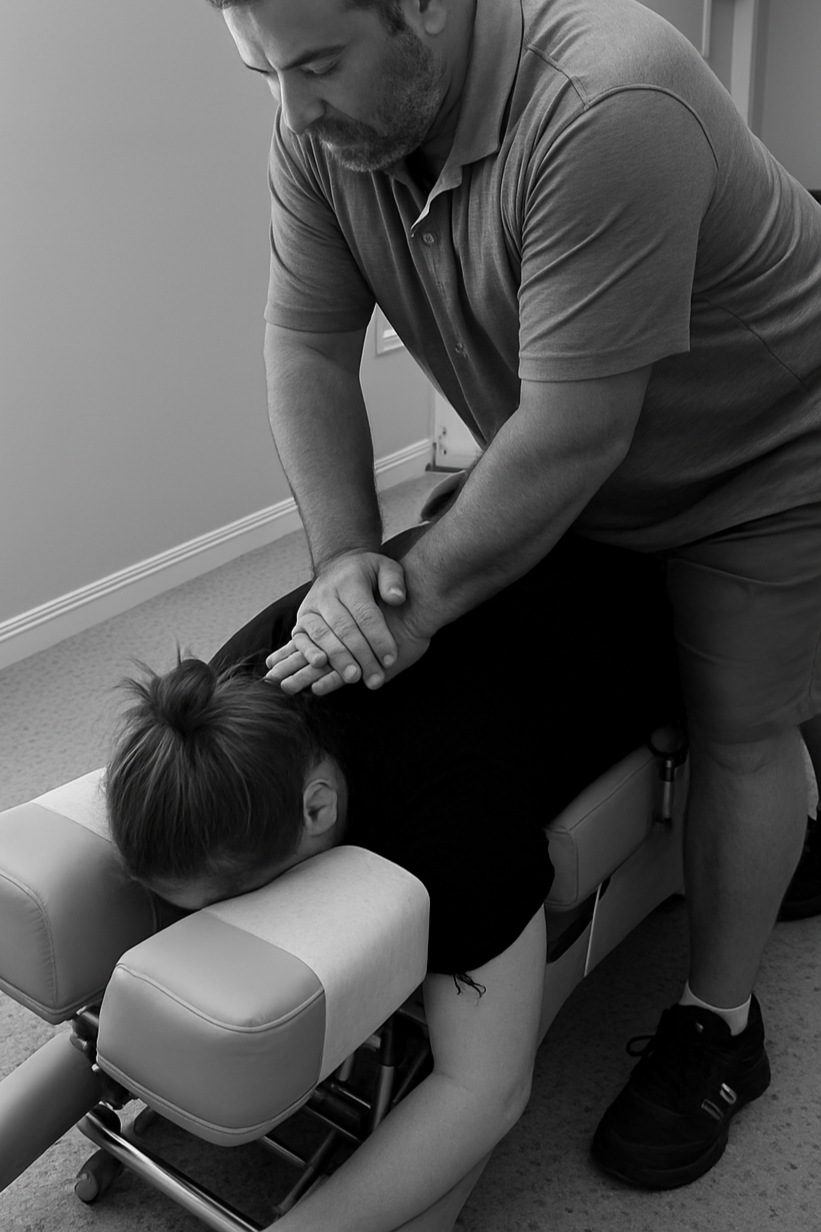
- Hands-on adjustments: When appropriate, adjustments can support mobility in the spine or related joints that influence movement.
- Shockwave therapy: This non-invasive option uses sound waves and may be considered for certain stubborn muscle, tendon, or soft-tissue concerns. Learn more through our shockwave therapy information.
- Decompression therapy: This may be relevant when back-related or nerve-related problems contribute to lower-extremity symptoms. It is not automatically the right tool for every knee concern.
- Rehabilitative exercises: Strength, balance, mobility, and movement retraining help you build capacity between visits.
- Stretching and posture guidance: Simple changes can support better movement at home and during work or exercise.
- Dry needling: When clinically appropriate, this may be used as an additional option for certain muscle-related complaints.
The goal is not to use every service. The goal is to choose the appropriate combination after a thorough assessment.
Ask these questions before booking
A short phone conversation can help you decide whether a clinic is a good fit. Consider asking:
- Do you regularly evaluate knee and lower-extremity concerns?
- What happens during the first appointment?
- Will you assess my hip, ankle, foot, and lower back?
- Do you provide rehabilitative exercises?
- How do you decide whether shockwave or decompression therapy is appropriate?
- What symptoms would lead you to refer me to an orthopedist?
- How will you measure progress?
- Will my treatment plan be customized to my activities and goals?
- Do you care for patients in my age group?
- What should I bring to the first visit?
Pay attention to how the person responds. Do they listen? Do they ask questions? Do they make room for uncertainty? A thoughtful answer is often more helpful than a promise of a quick fix.
Read reviews for signs of thorough care
Reviews can help you understand what a clinic feels like from a patient’s perspective. Look beyond star ratings and search for specific details.
Helpful signals include comments about:
- The provider listening carefully
- A detailed first appointment
- Clear explanations
- Personalized treatment plans
- Progress over several visits
- Support returning to walking, exercise, running, or lifting
- A welcoming experience for older adults and families
Be cautious if reviews repeatedly mention rushed appointments, pressure to commit to care, or the same treatment being used for everyone. You should feel comfortable asking questions and discussing your goals.
Personalized care in North Knoxville
At Knox Chiro, we take time to listen before creating a customized plan. Our goal is to help you feel better, move better, and return to the activities that matter to you, whether that means running, lifting weights, working comfortably, or simply walking with more confidence.
We care for patients of all ages and provide hands-on chiropractic care, decompression therapy, shockwave therapy, and rehabilitative exercises in a welcoming setting.
You can find us at 3371 Whittle Springs Road, Knoxville, TN 37917, serving the Whittle Springs and North Knoxville area.

Take the next step at your pace
You don’t have to decide everything before you call. We’ll listen to what’s happening, answer your questions, and help you understand whether an appointment is a reasonable next step.
Call (865) 687-5700 or fill out our contact form and ask for a call back. We’ll be happy to learn more about your knee concerns and help you choose a path forward.
This article is for general education and does not replace an in-person medical evaluation. If you have severe pain, major swelling, a deformity, fever, or cannot bear weight, seek urgent medical care.
SEO title: Best Chiropractor for Knee Pain in Knoxville: How to Choose
URL slug: /best-chiropractor-for-knee-pain-knoxville-how-to-choose/
Meta description: Choosing the best chiropractor for knee pain knoxville? Compare care options, red flags, assessment steps, and questions to ask before you book in Knoxville.