Chiropractic Care for Knee Pain: Why It Works Beyond the Knee

SEO title: Chiropractic Care for Knee Pain | Knoxville, TN
URL slug: /blog/chiropractic-care-for-knee-pain-beyond-the-knee
Meta description: Chiropractic care for knee pain in Knoxville, TN looks beyond the joint with gait, hip, ankle, hands-on care, exercise, and a plan built for you today.
Knee pain can make simple activities feel difficult. Walking through the grocery store, climbing stairs, getting up from a chair, or returning to a favorite workout may all become less comfortable.
At Knox Chiro, we believe chiropractic care for knee pain should begin with a careful look at the whole body, not just the place that hurts. Your knee works as part of a connected movement system. The hip, pelvis, ankle, foot, and lower back all influence how much force reaches the knee.
That’s why we take time to listen, understand your symptoms, assess how you move, and create a plan that fits your goals. Whether you want to run again, return to lifting weights, or simply walk comfortably, our goal is to help you make steady progress.
Why Chiropractic Care for Knee Pain Looks Beyond the Joint
Your knee sits between two important areas: the hip above it and the ankle below it. When one part of that chain becomes stiff, weak, or less coordinated, the knee may have to handle more stress than it should.
For example:
- A stiff ankle may limit how your leg moves when you walk, squat, or run.
- A weak hip may allow the knee to move inward during stairs or single-leg activities.
- Limited hip motion may shift extra pressure toward the knee.
- A change in pelvic or lower-back movement may affect your stride and muscle control.
- Foot mechanics may change the way force travels up through the leg.
This does not mean every knee problem starts somewhere else. Sometimes the knee itself is the main source of pain. But assessing the entire chain helps us understand what may be contributing to your symptoms.
Research reviews have found that manual therapy can be more useful when combined with exercise and broader rehabilitation rather than used by itself. The American College of Physicians discussion of manual therapy and musculoskeletal care is one example of the wider evidence clinicians consider when planning conservative care.

What Chiropractic Care for Knee Pain May Include
Your first visit begins with a conversation. We’ll ask when your pain started, what makes it better or worse, how it affects your daily activities, and what you would like to do again.
Then we may assess:
- Your walking pattern and gait
- Knee movement and stability
- Hip strength and range of motion
- Ankle mobility
- Foot and pelvic alignment
- Lower-back movement
- Balance, coordination, and single-leg control
- The way you squat, step, bend, or climb stairs
This thorough assessment helps us avoid guessing. It also helps us determine whether your symptoms appear to be coming mainly from the knee, influenced by another area, or potentially referred from the hip or lower back.
Depending on what we find, your plan may include:
- Hands-on joint mobilization or adjustments
- Soft-tissue and myofascial techniques
- Mobility work for the hip, ankle, or knee
- Posture and movement guidance
- Rehabilitative exercises
- Shockwave therapy for selected tendon problems
- Decompression therapy or spinal care when appropriate
- Dry needling when clinically appropriate and included in your plan
Our about page explains more about our hands-on approach and the range of care we provide for patients of all ages.
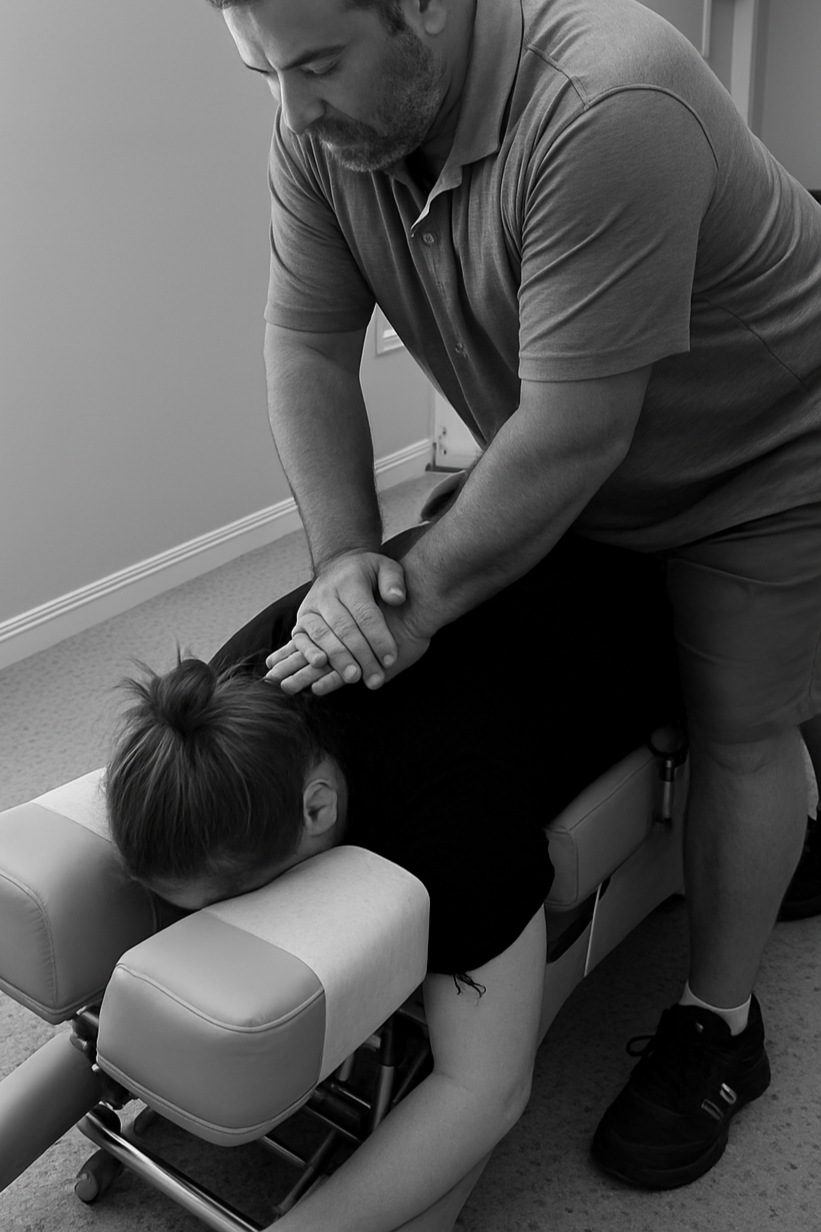
Hands-On Care Helps Restore Movement
When a joint does not move well, nearby muscles may work harder to create the movement you need. That can contribute to tightness, compensation, and irritation over time.
Hands-on care may help restore motion in the knee, but it may also be directed toward the joints above and below it. For some patients, that means working with the hip, pelvis, ankle, or foot. For others, the lower back may need attention because it is affecting movement through the leg.
The purpose is not to force a joint into a particular position or promise an instant fix. It is to help improve movement and make it easier for you to use the area normally.
A hands-on session may be followed by gentle movement testing. This allows us to see whether your range of motion, walking pattern, or comfort has changed. Your plan can then be adjusted based on how your body responds.
Exercise Helps You Keep the Progress
Hands-on care and exercise work best together.
Manual therapy may help you move more comfortably during a visit. Rehabilitative exercises help you build the strength, control, and confidence to use that improved movement in daily life.
Your exercises may focus on:
- Hip and glute strength
- Quadriceps and hamstring control
- Calf strength
- Ankle mobility
- Balance and coordination
- Step-down and squat mechanics
- Gradually increasing walking, running, or lifting demands
The right exercise depends on your current ability. We won’t ask you to perform a movement that does not match your stage of recovery. Instead, we’ll start where you are and progress gradually.
This combination is an important part of chiropractic care for knee pain because it gives you an active role in your recovery. You are not simply waiting for treatment to work. You are learning how to move, load, and strengthen your body with better control.

When Shockwave Therapy May Fit
Some knee symptoms are related to irritated or stubborn tendons, such as the patellar tendon below the kneecap. When tendon pain continues despite changes in activity and a consistent exercise plan, shockwave therapy may be considered.
Shockwave therapy uses sound waves to stimulate a targeted area. It is non-invasive and does not involve surgery or medication. It is generally used as part of a broader plan rather than as a stand-alone solution.
The treatment is not appropriate for every person or every cause of knee pain. That’s why we first assess your symptoms and determine whether the involved tissue appears to be a good fit.
You can learn more through our Shockwave Therapy: The Basics Explained video. We’ll also explain what to expect and how shockwave therapy may fit with your exercises and other care.

Is the Pain Coming From the Knee?
Not all pain felt around the knee comes from the knee joint itself.
The hip can refer discomfort into the thigh or knee area. Problems involving the lower back may also cause symptoms that travel into the buttock, thigh, or leg. Changes in nerve sensitivity can sometimes create pain, tingling, numbness, or weakness that feels separate from the original source.
During an evaluation, we look for clues such as:
- Pain that changes with lower-back movement
- Symptoms that travel below the knee
- Numbness, tingling, or weakness
- Hip stiffness or reduced hip rotation
- Knee pain without clear tenderness in the knee
- Symptoms that change when you sit, stand, walk, or bend
If your symptoms suggest a condition that needs medical imaging, orthopedic evaluation, or another type of care, we’ll explain that. Good care includes knowing when to coordinate with another provider.
You should seek prompt medical attention after a major injury, if you cannot bear weight, if the knee is visibly deformed or locked, or if you have significant swelling with fever, redness, or unusual warmth. Sudden calf swelling or shortness of breath also requires urgent medical attention.
What Progress May Look Like Week to Week
Every person responds differently, but your progress may follow a general pattern.
Week one: We focus on understanding the problem, establishing a baseline, and reducing aggravating movements. You may begin with gentle mobility work and simple exercises.
Weeks two and three: We look for changes in walking, stairs, range of motion, and daily comfort. Exercises may become more active as your body tolerates them.
Weeks four and beyond: The focus often shifts toward strength, balance, and returning to the activities you care about. A runner may begin a gradual return-to-running plan. Someone who lifts weights may work on controlled squats, hinges, and progressive loading.
Progress is not always perfectly linear. A busy day, a new activity, or an increase in training may temporarily increase soreness. We’ll monitor your response and adjust the plan rather than pushing through symptoms without guidance.
The aim of chiropractic care for knee pain is practical: help you move better, build capacity, and feel more confident using your body.
Personalized Care in North Knoxville
If you live in Whittle Springs, North Knoxville, or elsewhere in the Knoxville TN area, you don’t have to figure out persistent knee pain alone.
At Knox Chiro, we take the time to hear your concerns before recommending a plan. We care for patients of all ages and tailor treatment to your current needs, health history, and goals.
Our FAQs provide more information about first visits, hands-on adjustments, shockwave therapy, and other services.
If you’re ready to talk about your knee pain, call (865) 687-5700. You can also fill out our contact form, and we’ll be happy to call you back. We’ll listen, answer your questions, and help you decide on a simple next step.