Sports Knee Injury? Chiropractic Care in Knoxville, TN

SEO title: Sports Knee Injury Chiropractor Knoxville | TN
URL slug: /blog/sports-knee-injury-chiropractor-knoxville/
Meta description: A sports knee injury chiropractor knoxville visit helps athletes assess injuries, restore movement, and return to sport safely with a personalized plan.
You cut across the field, landed from a jump, or pushed through one more set at the gym, and your knee suddenly felt wrong. A sports knee injury chiropractor knoxville evaluation can help you understand what may be happening and what to do next.
At Dr. Arthur Poisal Chiropractic, we work with active people of all ages, including young athletes. We take time to listen, examine how you move, and build a plan around your sport, schedule, and goals. Early, structured care is often a better option than limping through the season and hoping the problem disappears.
What kind of knee injury happened?
Not every sports injury affects the knee in the same way. Understanding the basic differences can help you recognize when you may need imaging or an orthopedic referral.
Strain
A strain affects a muscle or tendon. It can happen when you sprint, jump, lift, or suddenly increase your training load. A strain may cause soreness, tightness, weakness, or pain when you contract the involved muscle.
Mild strains often improve with relative rest, movement that stays within your comfort level, hands-on care, and gradual strengthening. More significant injuries may need additional evaluation, especially if you felt a sudden pop or cannot use the leg normally.
Sprain
A sprain affects a ligament, the strong tissue that connects one bone to another. The MCL, LCL, ACL, and PCL are all important knee ligaments.
A mild sprain may cause tenderness and discomfort without major instability. A more serious sprain can lead to swelling, a feeling that the knee may give way, or difficulty changing direction. Higher-grade ligament injuries should be evaluated carefully. An MRI and orthopedic referral may be appropriate if there is significant instability, rapid swelling, or concern for a partial or complete tear.
Meniscus injury
The meniscus is a cushion of cartilage inside the knee. Twisting while the foot is planted can irritate or tear it. Symptoms may include pain along the joint line, catching, clicking, swelling, or discomfort with squatting and pivoting.
A stable meniscus injury may respond to conservative care. However, a knee that truly locks and cannot fully straighten needs prompt medical evaluation. Recurrent swelling, persistent catching, or symptoms that do not improve may also call for imaging and an orthopedic opinion.
Ligament injury
Ligament injuries range from mild stretching to complete tears. A knee that gives way after a pivot, collision, or awkward landing may have a more significant ligament injury.
You should seek prompt medical care for a visibly deformed knee, inability to bear weight, major swelling that appears quickly, severe instability, numbness, a cold or pale foot, or intense pain after a high-impact collision. These signs may indicate a fracture, dislocation, vascular problem, or complex injury.
When in doubt, it is safer to have the knee assessed rather than trying to train through a potentially serious problem.

Why we assess the whole leg
Your knee does not work by itself. It sits between the hip and ankle, and changes anywhere along that chain can affect the way force travels through the leg.
For example, limited hip control may cause your knee to move inward during a landing. A stiff ankle may change your squat, running stride, or ability to absorb force. Weakness in the hip or foot may also cause you to place more stress on the knee than it can comfortably handle.
During your evaluation, we may look at:
- Walking, jogging, squatting, and single-leg balance
- Hip strength and control
- Ankle mobility
- Foot position and stability
- Knee range of motion
- Swelling, tenderness, and joint-line sensitivity
- How the leg responds to sport-specific movements
This thorough assessment helps us avoid focusing only on the spot that hurts. Your knee may be where you feel the problem, but the movement pattern contributing to it may begin higher or lower in the leg.
What care may include
Treatment depends on your findings, injury stage, and goals. We do not use the same plan for every athlete.
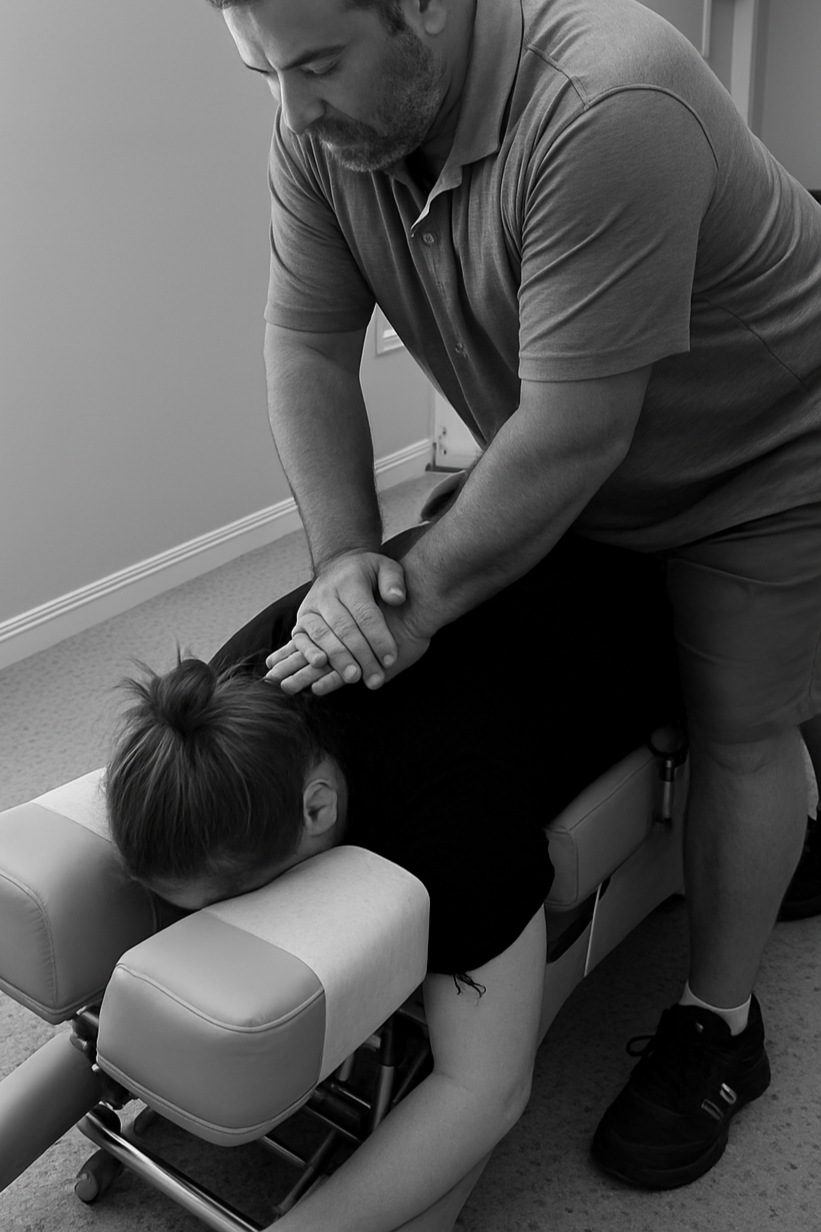
Hands-on care may help restore comfortable motion in the joints around the knee, hip, pelvis, and ankle. Soft tissue work can address tight or overloaded muscles and tendons in the thigh, calf, and lower leg.

For stubborn tendon pain, shockwave therapy may be considered when appropriate. It is a non-invasive treatment option that uses acoustic energy to support the body’s response in an irritated tendon. You can learn more about this service in our shockwave therapy overview.
Rehabilitative exercises are another important part of care. Depending on your needs, your plan may include strength, mobility, balance, landing, and gradual loading exercises. Chiropractic adjustments, decompression therapy, and other services may also be included when they fit your overall condition.
Our goal is not simply to make the knee feel better for one day. We want to help you move with greater confidence and build the strength and control needed for your activities.
When should you train, and when should you back off?
Some soreness during recovery does not always mean you must stop all movement. In many cases, staying gently active can help prevent stiffness and maintain strength.
You may be able to continue modified training when:
- You can walk without a significant limp
- Pain stays mild and does not worsen during or after activity
- The knee is not becoming more swollen
- You can control the movement without compensation
- You can modify speed, range, resistance, or direction
Back off and arrange an evaluation when pain is sharp, swelling is increasing, the knee gives way, or you cannot perform basic movements safely. You should also stop if you feel catching or locking, especially during pivoting or bending.
Training through an injury often changes your mechanics. You may shift your weight, shorten your stride, or avoid one side. That compensation can place extra stress on your other knee, hip, back, or ankle.
A step-by-step return to sport
Returning to soccer, basketball, football, running, or lifting should be a progression, not a single decision.
We may move through stages such as:
- Settle symptoms: Reduce aggravating activity while maintaining comfortable movement.
- Restore motion: Work toward comfortable knee, hip, and ankle range of motion.
- Build strength: Improve the muscles that support the knee and control the leg.
- Train balance: Practice single-leg control and stable landing mechanics.
- Add linear activity: Progress from walking to jogging, then controlled acceleration.
- Introduce sport demands: Add jumping, cutting, pivoting, contact preparation, or lifting patterns.
- Return gradually: Increase practice intensity before returning to full competition.
Before returning to unrestricted play, you should be able to move through sport-specific drills without significant pain, swelling, instability, or protective compensation. Your strength, balance, and confidence should also be close to the level of your uninjured side.
The timeline varies. A mild strain may progress differently from a ligament injury or meniscus problem. We will help you understand what your knee can handle now and what needs more time.

Rehabilitative exercises help prevent another injury
Feeling better is only part of recovery. Your risk of reinjury may remain if the original strength or movement problem has not been addressed.
Rehabilitative exercises can help you improve:
- Quadriceps and hamstring strength
- Hip and glute control
- Calf and ankle capacity
- Balance and coordination
- Deceleration and landing mechanics
- Tolerance for running, jumping, and lifting
The right exercises should match your current ability. Starting too aggressively can irritate the knee, while doing too little may not prepare you for your sport. We can adjust your plan as your strength and confidence improve.
Whether you want to return to running, lift weights without hesitation, play a full basketball game, or simply walk comfortably again, personalized care can make the next step clearer.
Get a personalized knee assessment in Knoxville
If you injured your knee in a Whittle Springs or North Knoxville gym, field, court, or training facility, you do not have to guess whether you should rest, train, or seek help.
At Dr. Arthur Poisal Chiropractic, we will listen to what happened, assess the entire leg, and explain your options. If your symptoms suggest the need for imaging or orthopedic care, we will help point you in the right direction. When conservative care is appropriate, we will create a plan designed around your movement goals.
Call us at (865) 687-5700 or fill out our contact form and request a call back. We’ll be happy to help you take the next step.