Support for the movement you want to keep
Chiropractic Adjustments & Mobility Care
Hands-on care and simple practice for staying steady, capable, and involved in your life.
Mobility is not a test you pass or fail. It changes with age, injury, work, confidence, and daily habits. We combine careful chiropractic adjustments with rehabilitative exercises to help you keep doing the things that matter.
Who this helps
Care for the life you’re trying to get back to.
Seniors who want to protect independence, walking confidence, balance, and the ability to manage everyday tasks may find this approach reassuring.
Adults who feel stiff after sitting, driving, or a period of inactivity can start with small, achievable movement goals.
People recovering from an injury often need both hands-on support and practice using the body again in a safe, progressive way.
Anyone who has been told that stiffness is simply something to accept can benefit from understanding what movement is still available and how to build on it.
How it works
A clearer plan, explained in plain language.
Meet you where you are
We consider pain, balance, strength, confidence, health history, and the daily tasks you want to keep doing.
Improve a restriction
A gentle adjustment or other hands-on technique may help a joint move more comfortably for the work that follows.
Practice what matters
Simple exercises build usable strength, balance, and confidence without turning care into a performance.
Your care experience
What a visit and course of care can look like.
Your first visit begins with your goals. Maybe stairs have become harder, reaching a shelf feels uncertain, or you want to keep walking with friends. We ask about falls, surgeries, medications, osteoporosis, joint replacements, and other health factors that influence what is safe. The assessment stays respectful and unhurried, especially when you have felt dismissed elsewhere.
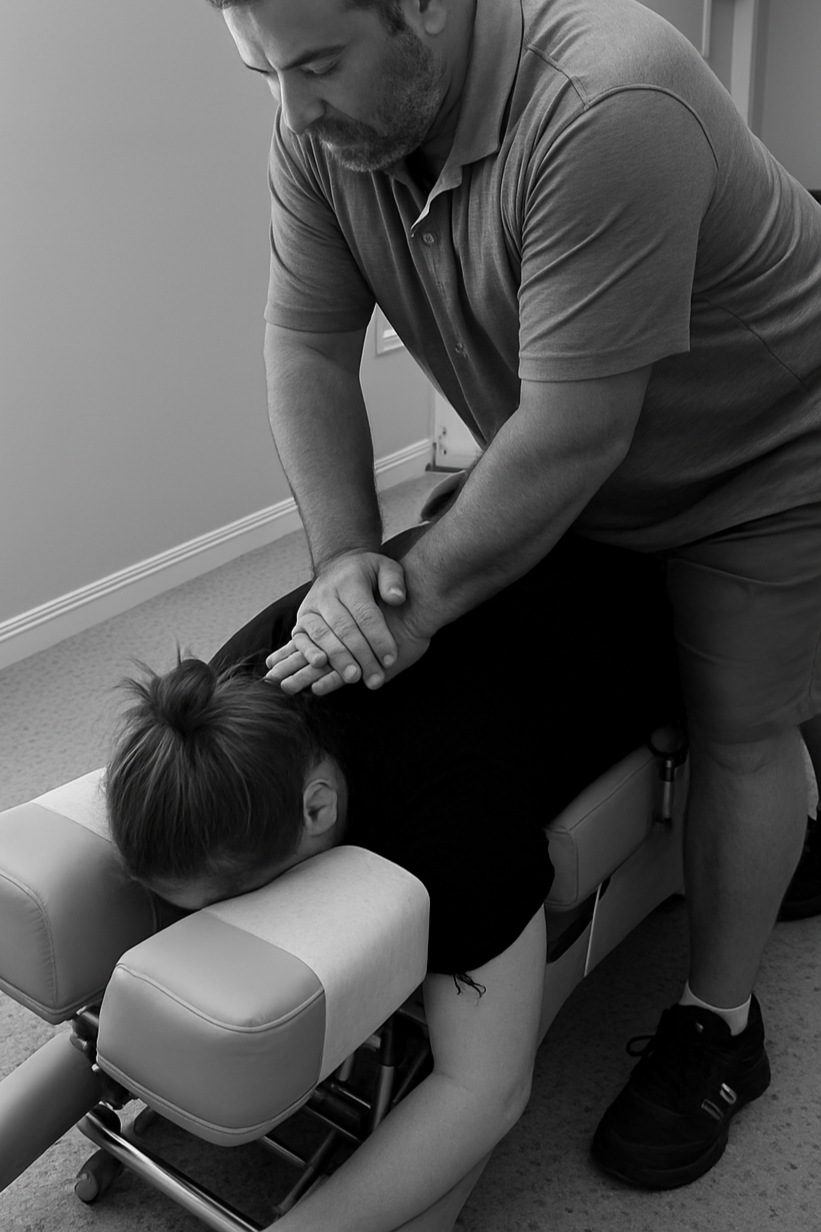
Depending on what we find, care may include a gentle chiropractic adjustment, guided joint movement, soft-tissue work, or a few targeted exercises. Adjustments are not a test of toughness and are never the whole point. They may make movement more comfortable in the moment, giving you a better opportunity to practice the strength and control your daily life requires.
A course of care is built around repetition you can manage. We may use sit-to-stand work, walking practice, hip and upper-back mobility, balance drills, or light resistance. The exercises are chosen for your home and your confidence level. We progress when the current step feels dependable, not because a calendar says you should be doing more.
Results and honest limits
Progress should feel useful in real life.
More confidence with walking, stairs, reaching, turning, or getting up from a chair.
Less stiffness and fewer movement compensations during everyday tasks.
A small set of exercises you can understand, repeat, and adjust as life changes.
What this care cannot promise
Adjustments and mobility exercises cannot stop aging or guarantee that a fall, arthritis flare, or new health problem will never happen. Some balance changes, sudden weakness, unexplained falls, or severe pain need medical evaluation. We adapt care to your health history and will recommend another professional when that is the safer choice.
If your symptoms suggest something outside chiropractic care, we’ll tell you and help you understand the next appropriate step.
Questions patients ask
A little more clarity before you call.
Are chiropractic adjustments safe for older adults?
Safety depends on the person, their health history, and the technique used. We ask detailed questions and choose a gentle approach that matches your comfort and needs.
What if I am not flexible or strong?
That is exactly where a starting point is useful. Exercises can be scaled to a chair, a countertop, or a short walk and built up gradually.
How often should I do the exercises?
We prefer a manageable amount you can repeat consistently. You will receive clear guidance and we can adjust the plan if it is too easy, too hard, or difficult to fit into your routine.
Can mobility care help after a fall?
It may help with recovery and confidence, but a fall should be medically assessed when there is injury, head impact, new confusion, or a sudden change in balance.
Keep exploring
Related care and useful reading.
Ready to talk it through?
Start with a conversation, not a commitment.
Tell us what’s been going on, what you’ve tried, and what you’d like to do more comfortably. We’ll help you find the right place to begin.