For the tension you keep carrying
Neck & Shoulder Pain Relief
Loosen the grip of daily tension and make your neck and shoulders feel more at home.
Neck and shoulder pain can build quietly through screen time, stress, sleep position, driving, or training. We look at the whole pattern so care supports your actual workday and not just the sorest spot.
Who this helps
Care for the life you’re trying to get back to.
Desk workers and drivers may benefit when hours of looking down, reaching forward, or holding one position leave the neck and shoulders tight.
People with recurring tension headaches, upper-back ache, or a shoulder that never quite settles can use an assessment to find a more useful starting point.
Active adults often need help after lifting, swimming, racquet sports, or a sudden change in training exposes a movement restriction.
This is also for anyone who has been told to simply ‘fix your posture’ but has not been shown what to change or how to make it manageable.
How it works
A clearer plan, explained in plain language.
Map the pattern
We ask about screens, sleep, stress, work, training, headaches, and the positions that change your symptoms.
Restore options
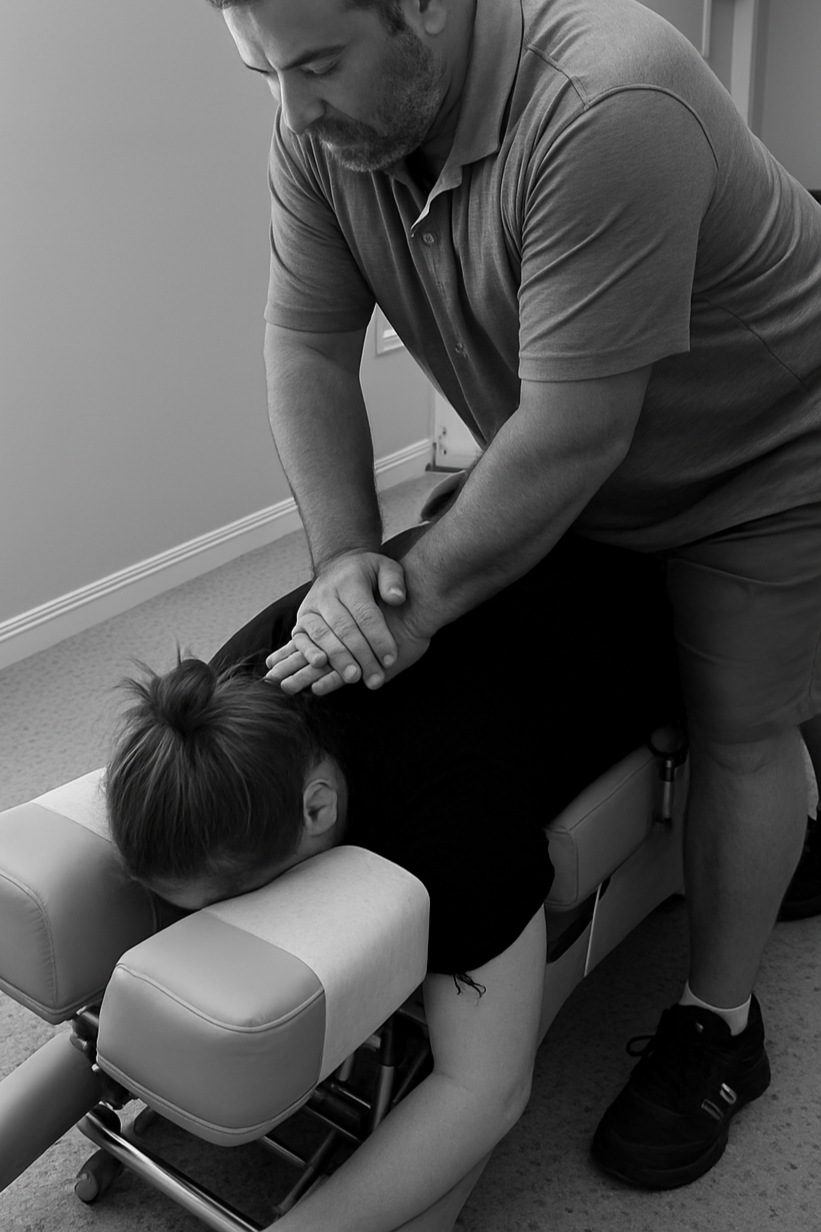
Gentle hands-on care and mobility work help the neck, upper back, ribs, and shoulders share the job again.
Change the load
Small adjustments to your desk, breaks, breathing, and strength can make progress easier to keep.
Your care experience
What a visit and course of care can look like.
We start by separating ordinary tension from symptoms that need a different level of evaluation. You will have time to describe what you feel, when it appears, and what you are afraid it might mean. We pay attention to arm symptoms, headaches, dizziness, trauma, and changes in strength because those details shape what is safe and appropriate.
Your assessment may include comfortable neck and shoulder movement, upper-back mobility, and a look at how your head, ribs, and shoulder blades work together. Treatment might include a gentle adjustment, soft-tissue work, guided movement, or a short exercise. Nothing is done just because it is part of a routine; every piece should have a reason you can understand.
A course of care usually combines in-office support with small changes you can repeat during a workday. That might mean a screen brought closer to eye level, a two-minute movement break, better shoulder control, or a more comfortable sleep setup. The goal is not a rigid posture. It is having more choices and less sensitivity when your day demands a lot of your upper body.
Results and honest limits
Progress should feel useful in real life.
Less frequent or intense tension during screens, driving, or long workdays.
More comfortable neck rotation, reaching, lifting, or overhead movement.
A realistic plan for breaks and strength rather than a demand to hold one perfect posture.
What this care cannot promise
Neck pain has many possible causes, and chiropractic care is not the right answer for every headache, injury, or neurological symptom. A sudden severe headache, new weakness or numbness, trouble speaking, loss of coordination, fever, or significant trauma needs urgent medical assessment. We will be honest about when your symptoms belong with another clinician.
If your symptoms suggest something outside chiropractic care, we’ll tell you and help you understand the next appropriate step.
Questions patients ask
A little more clarity before you call.
Is my desk really causing my neck pain?
A desk setup may contribute, but pain is rarely explained by posture alone. Sleep, stress, strength, movement variety, and total workload all matter, so we look at the full picture.
Can care help tension headaches?
It may help when headaches are connected to neck or upper-back sensitivity, but headaches have many causes. We screen for warning signs and refer when another evaluation is needed.
Will treatment involve a neck adjustment?
Possibly, but only if it fits your assessment and comfort. There are many ways to work with the neck, upper back, shoulders, and supporting muscles.
What can I do during a workday?
Changing position often, moving the upper back, and making your screen and keyboard easier to reach are usually more useful than trying to hold a stiff posture all day.
Keep exploring
Related care and useful reading.
Ready to talk it through?
Start with a conversation, not a commitment.
Tell us what’s been going on, what you’ve tried, and what you’d like to do more comfortably. We’ll help you find the right place to begin.